

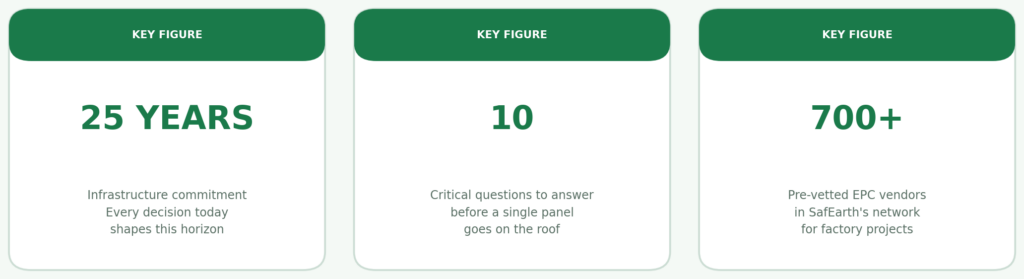
Most factories that have a bad solar experience share the same root cause: they moved to installation before they understood the decision. Solar is a 25-year infrastructure commitment. The panels, inverters, and cables installed this quarter will still be generating — or failing to generate — in 2049. Here are the ten questions every factory head and CFO should have answered before a single panel goes on the roof.
1. What Is My Actual Daytime Load — and When Does It Peak?
Solar generates between 8am and 5pm. Every unit your factory consumes directly during those hours avoids a full grid purchase. The right system size is determined by your daytime consumption profile, not your total monthly electricity bill. Pull your interval meter data — 15-minute consumption readings across at least 3 months — and understand your load curve before any design work begins. This one step prevents the most common sizing mistake in industrial solar: over-building for generation rather than consumption.
2. What Is My Roof’s Actual Available Area — and Is It Structurally Sound?
Available rooftop area is rarely what it looks like on a site plan. Water tanks, HVAC equipment, skylights, and fire-line access paths all reduce usable panel area. A structural assessment is non-negotiable before finalising system size — older industrial roofs frequently need reinforcement before they can carry the distributed load of a solar array. A thorough site survey — which SafEarth delivers before any DPR is issued — covers roof type, orientation, tilt angle, shading analysis, and structural load capacity.
3. Which Financing Model Fits My Business?
Capex, PPA, or group captive — each produces a fundamentally different financial outcome. Profitable companies with taxable income benefit most from Capex ownership and 40% accelerated depreciation in Year 1 under Section 32. Companies in a MAT position often find PPA more competitive. SafEarth’s Capex vs PPA decision guide maps both models to your context. For facilities needing scale beyond rooftop capacity, open access and group captive solar provide alternative routes to the same locked-in energy cost.
4. How Was This System Sized — and What Assumptions Were Used?
Every solar proposal contains assumptions: panel efficiency, performance ratio, degradation rate, solar irradiance, and load match percentage. A knowledgeable partner will walk you through their assumptions and help you maximise savings, not just close a deal. Ask your EPC to show you the sizing model — not just the output. Ather Energy engaged SafEarth specifically to evaluate the internal calculations behind their manufacturing-scale solar specifications, producing a comprehensive technical report that validated — and in some cases corrected — vendor assumptions.
5. What Is the EPC Partner’s Track Record in My Sector?
Industrial solar installation involves load synchronisation with manufacturing equipment, compliance with factory electrical standards, and coordination with production schedules to minimise downtime. An EPC that has only done residential or small commercial projects will be learning on your rupees. Ask for references in your specific industry — and speak to the plant head or CFO, not just the project manager. SafEarth’s network of 700+ pre-vetted EPC vendors is screened for sector-specific experience. Lamtuf Plastics used SafEarth’s bid analysis to select the optimal EPC partner from multiple competing quotes — the MD specifically highlighted the quality of that selection guidance.
6. What Equipment Is Being Specified — and Why?
Ask specifically about efficiency ratings, temperature coefficients, and annual degradation rates — these determine how much your system generates in Year 15 vs Year 1. Cheaper panels with higher degradation rates can cost more in lost generation over a 25-year horizon than the initial CAPEX saving. For Indian factory conditions — high ambient temperatures, dust, monsoon — panel selection requires site-specific analysis. Ask for the technical justification, not just the brand name.
7. What Happens If the System Underperforms?
Every solar proposal contains a generation estimate. Ask what contractual protection you have if actual generation falls short. For commercial and industrial clients, check if warranties cover performance metrics or uptime guarantees — not just equipment replacement. Toyota Techno Park India worked with SafEarth specifically because of the proactive quality assurance approach that protected long-term generation performance — not just commissioning-day output. See more results like this at SafEarth’s case studies.
8. What Are the Regulatory Approvals Required — and Who Manages Them?
Factory solar installations require DISCOM approval for grid connection, net metering registration, structural clearance, and in some states, pollution control board notifications. The timeline for these approvals varies — 4 to 12 weeks is common. Delays push back commissioning, which matters significantly if you’re targeting a full year of accelerated depreciation. Ask who owns the regulatory process, what the timeline assumptions are, and what happens if approvals are delayed. SafEarth’s management platform tracks regulatory milestones in real-time — ensuring nothing falls through the gap between procurement and operation.
9. What Does O&M Look Like for 25 Years?
Dust accumulation alone can reduce generation by 15–25% without regular cleaning. Inverter failures, loose DC connections, and hotspot development are silent performance killers that only show up in generation data if someone is monitoring. SafEarth’s solar O&M services cover real-time monitoring, generation analysis, and technical audits — keeping factory systems performing at design specifications across their full operational life. Before committing to any installation, have a concrete answer for who monitors generation daily and what the SLA terms are.
10. What Is the Real Payback — After Tax Benefits?
Simple payback understates returns for profitable factories. The complete calculation includes Year 1 accelerated depreciation, GST ITC recovery, and the compounding effect of grid tariff escalation widening annual savings every year. Use SafEarth’s industrial solar ROI calculator to model the full picture — not just the headline number.
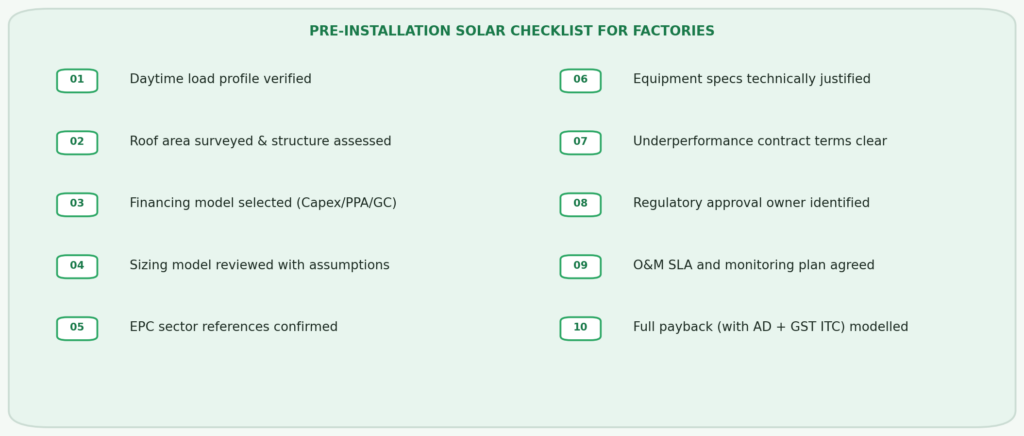
Your Pre-Installation Solar Checklist for Factories
Ready to unlock your solar advantage? Talk to our team of experts at SafEarth — and let’s build the system that works for your facility. Schedule a consultation at safearth.in/contact