
Capex vs Opex solar isn’t a question about which model is universally better. It’s a question about what your balance sheet looks like, what your tax position is, and how long you plan to stay in your facility. Get this decision right and solar compounds into a 25-year competitive advantage. Get it wrong and you leave significant value on the table.
What Is the Capex Solar Model?
Under the Capex model, your organisation purchases and owns the solar system outright — through direct capital expenditure or project financing. The asset sits on your balance sheet from Day 1, and so does the full benefit of ownership.
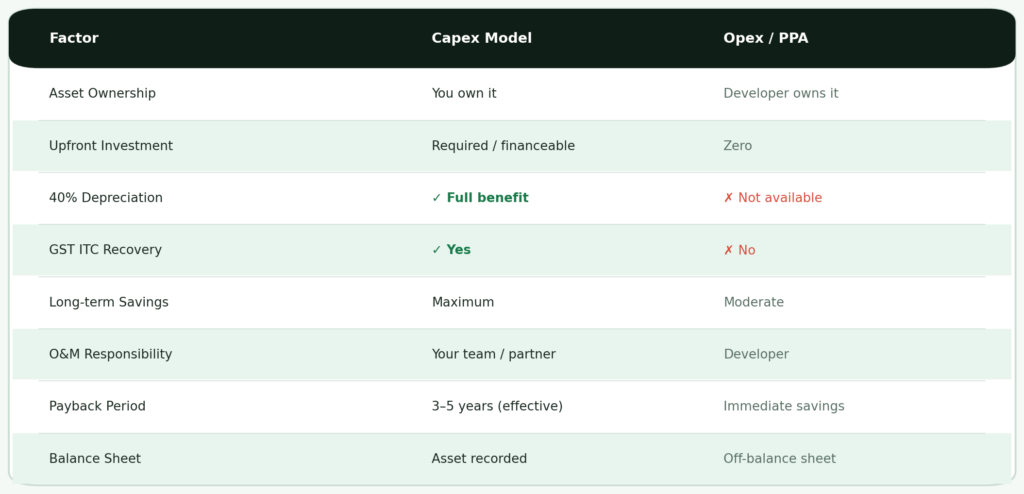
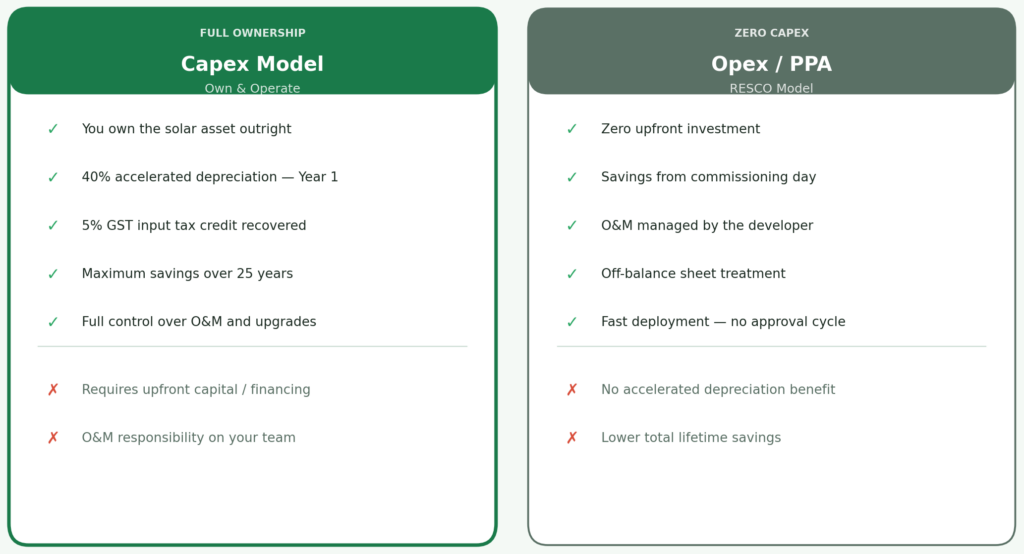
Full long-term savings: Every unit generated is valued at the full grid tariff avoided — ₹8–12/unit for most industrial consumers. Over 25 years, that spread compounds as grid rates rise while your solar generation cost stays fixed at ₹3–4/unit.
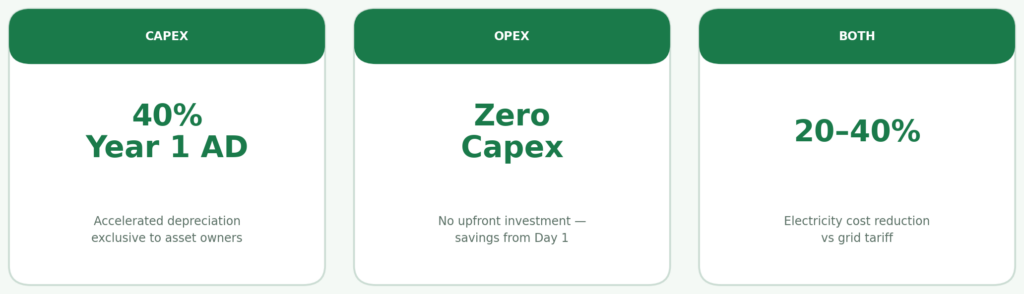
Accelerated depreciation: Under Section 32 of the Income Tax Act, C&I solar installations qualify for 40% accelerated depreciation in Year 1 — a benefit exclusive to asset owners. On a ₹5 crore plant, that’s ₹50 lakh in Year 1 tax cash flow benefit before a single unit of electricity is generated.

GST input tax credit: The 5% GST on solar equipment is fully recoverable as ITC for registered businesses — reducing effective project cost and compressing payback.
Atomberg’s CFO captured this precisely: they needed a true end-to-end partner, not a consultant. With SafEarth’s 48-hour DPR and reverse auction procurement saving up to 10% on Capex, ownership becomes financially optimal from the first decision.
What Is the Opex Solar Model?
Under the Opex model — also called RESCO or PPA — a third-party developer funds, builds, owns, and maintains the solar plant at your premises. You pay only for electricity generated under a long-term Power Purchase Agreement, typically 15–25 years.
Zero upfront capital: No approval cycle, no balance sheet impact. OPEX tariffs are typically 20–40% below grid rates, delivering immediate savings without capital deployment. The developer manages performance, maintenance, and monitoring — incentives stay aligned because their revenue depends on generation.
The trade-offs are equally clear: you don’t own the asset, so accelerated depreciation and GST ITC don’t apply. Long-term savings are capped by the PPA rate structure. Explore the full structure of solar PPA models for industrial buyers to understand the commitment before signing.
Capex vs Opex Solar: Direct Comparison
Which Capex vs Opex Solar Model Is Right for Your Industrial Facility?
The answer depends on three questions every CFO should answer before committing:
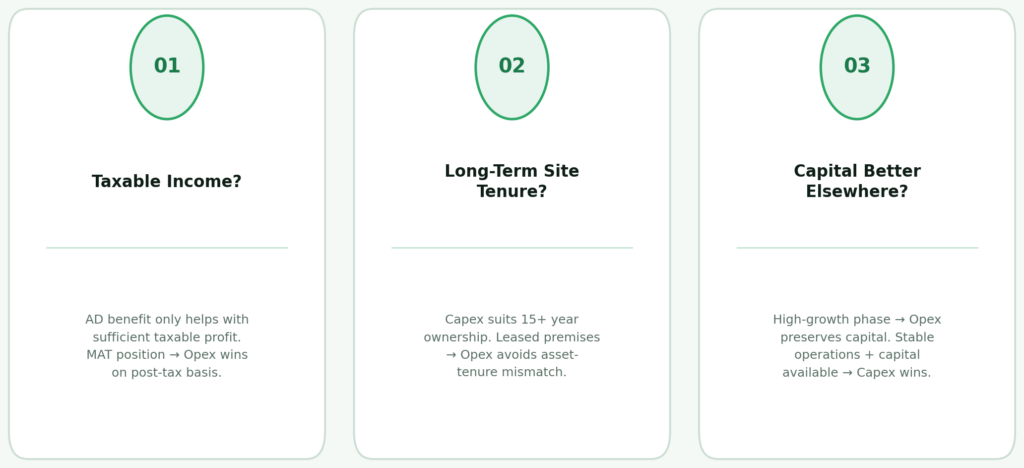
For companies needing open-access scale beyond rooftop capacity, group captive solar offers a third path — captive-level economics at larger scale. SafEarth’s full breakdown is in the Capex vs PPA decision guide. Model both scenarios against your actual numbers using the industrial solar profitability calculator.
FAQ: Capex vs Opex Solar for Industrial Consumers
Which Model Delivers Better Long-Term Savings — Capex or Opex?
Capex consistently delivers higher total savings over the system’s lifetime. For companies that want higher lifetime savings and complete ownership benefits, CAPEX offers greater long-term value. The 40% accelerated depreciation and GST ITC recovery mean the effective net investment is substantially lower than the headline figure — and 25-year savings run unencumbered by PPA rate structures.
Can an Industrial Company Switch from Opex to Capex Later?
Yes — most PPA agreements include a buyout option after 5–10 years at the depreciated asset value. The key is structuring the original PPA with a clearly defined buyout clause before signing. SafEarth includes PPA term review as a standard advisory step, ensuring industrial buyers retain optionality regardless of which model they start with.
What Happens to O&M Responsibilities Under Each Model?
Under Capex, O&M is your responsibility — and your leverage. You choose your partner, set SLA terms, and control monitoring frequency. Under Opex, the developer manages O&M — aligned with their generation revenue, but outside your direct control.
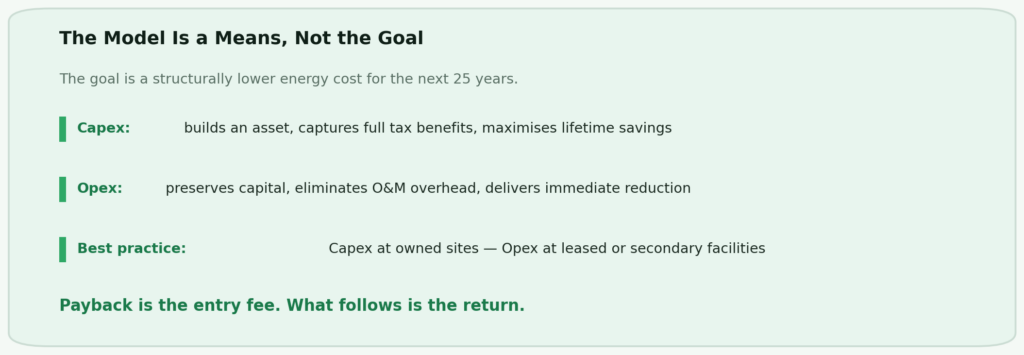
The Model Is a Means, Not the Goal
The goal is a structurally lower energy cost for the next 25 years. Both models deliver that. The right one depends on your capital position, tax profile, and facility tenure.
Most industrial companies deploying solar at scale use Capex at owned facilities and Opex at leased or secondary sites — a portfolio approach that captures the best of both.
Ready to unlock your solar advantage? Talk to our team of experts at SafEarth — and let’s build the system that works for your facility. Schedule a consultation at safearth.in/contact